
British, IB, American or Indian: which curriculum is right for your child in Dubai?
There is no single best curriculum in Dubai. The right one depends on three things: where your child may study after school, how your child learns, and how long your family expects to stay in Dubai. British, IB, American and Indian curricula are four major education routes, but families do not always compare all four at once. Each route makes sense under different circumstances, and all four can lead to strong universities and successful outcomes.
By Dubai School Match · Published 5 July 2026 · Last updated 5 July 2026

Dubai's 227 private schools offer 17 curricula. British, Indian, American and IB account for most enrolment, so this guide focuses on those four. It explains how each route works, what kind of learner it tends to suit, where it leads and what to watch before choosing.
In this article
- What should you decide before comparing curricula?
- How does the British curriculum work, and who is it for?
- What makes IB different?
- What does the American curriculum offer?
- How does the Indian curriculum work, and who is it for?
- How do British, IB, American and Indian curricula compare?
- How do the four compare on cost?
- Can your child switch curricula later?
- So how do you choose the right curriculum for your child?
- FAQ
What should you decide before comparing curricula?
Start with three questions.
Where may your child study after school? A family oriented toward the UK may prefer the directness of GCSEs and A-Levels. A family focused on the US or Canada may value an American diploma with AP courses. IB keeps options open across countries. CBSE offers continuity for families connected to the Indian education system and aligns directly with Indian university and entrance-exam pathways.
How does your child learn? Some children thrive on structure, clear milestones and exam rhythm. Others need breadth, electives or more inquiry-based learning. This question often matters more than the destination question, because a child can reach the same university through different systems with very different levels of friction.
How long are you staying in Dubai? For a short posting, continuity with the system your child already knows can matter more than switching to a locally popular curriculum. For a long stay, the full range of options becomes more realistic.
These questions do not produce a universal winner. They help identify which route deserves a place on your family's shortlist.
How does the British curriculum work, and who is it for?
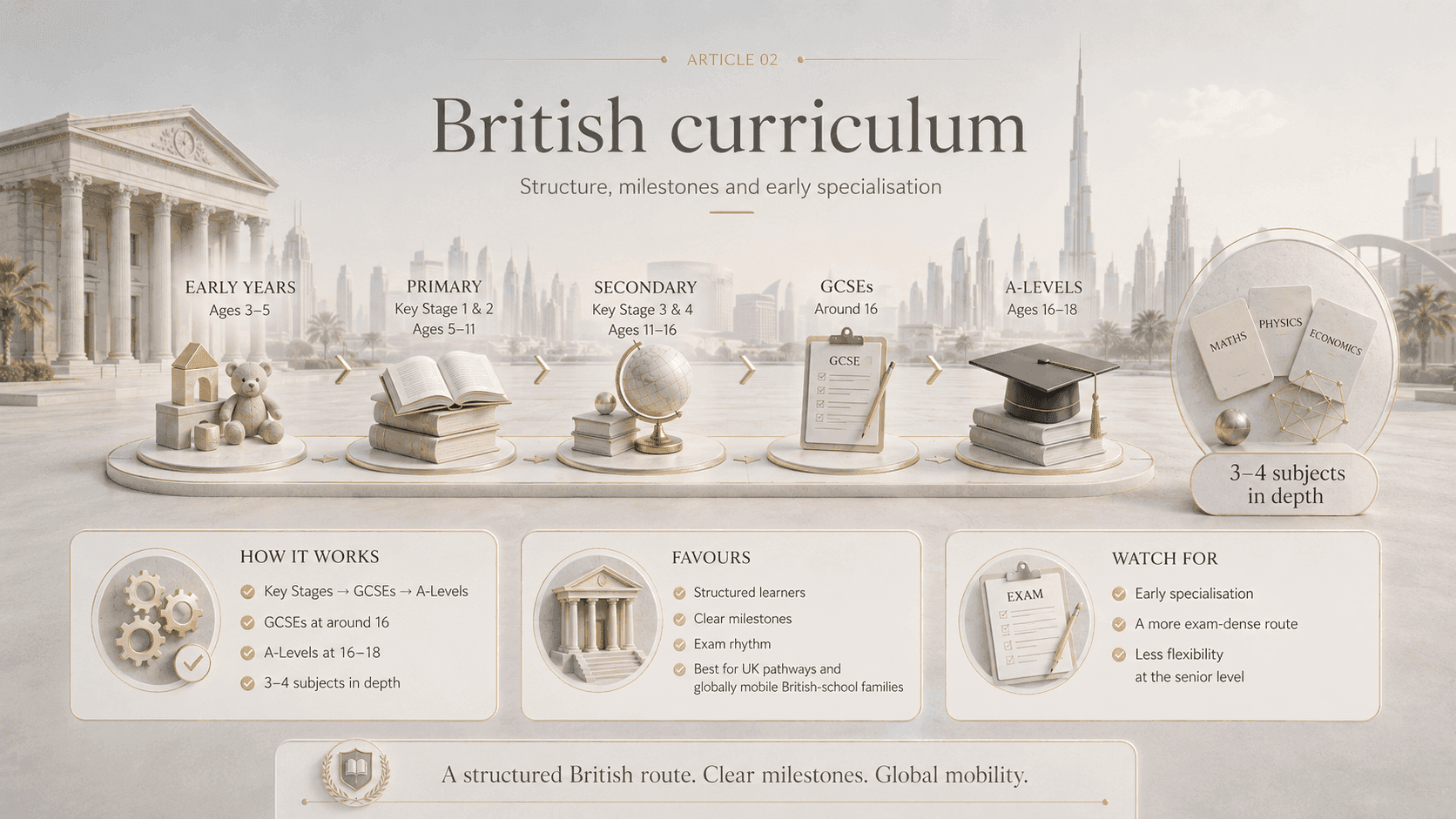
The British curriculum is the largest curriculum segment in Dubai. It is structured in Key Stages, with the defining feature arriving later: GCSEs around age 16, followed by A-Levels, where students typically narrow to three or four subjects studied in depth.
That early specialisation is both the system's strength and its constraint. A student who knows their direction can go deep quickly. A student who is still exploring must make choices earlier than they may feel ready for.
Often suits: children who respond well to clear structure, defined milestones and an exam rhythm; families oriented toward UK universities; students who are comfortable specialising in later secondary school.
Watch for: the system is more exam-dense than some alternatives. That motivates some children and exhausts others. Temperament matters as much as academic ability.
What makes IB different?
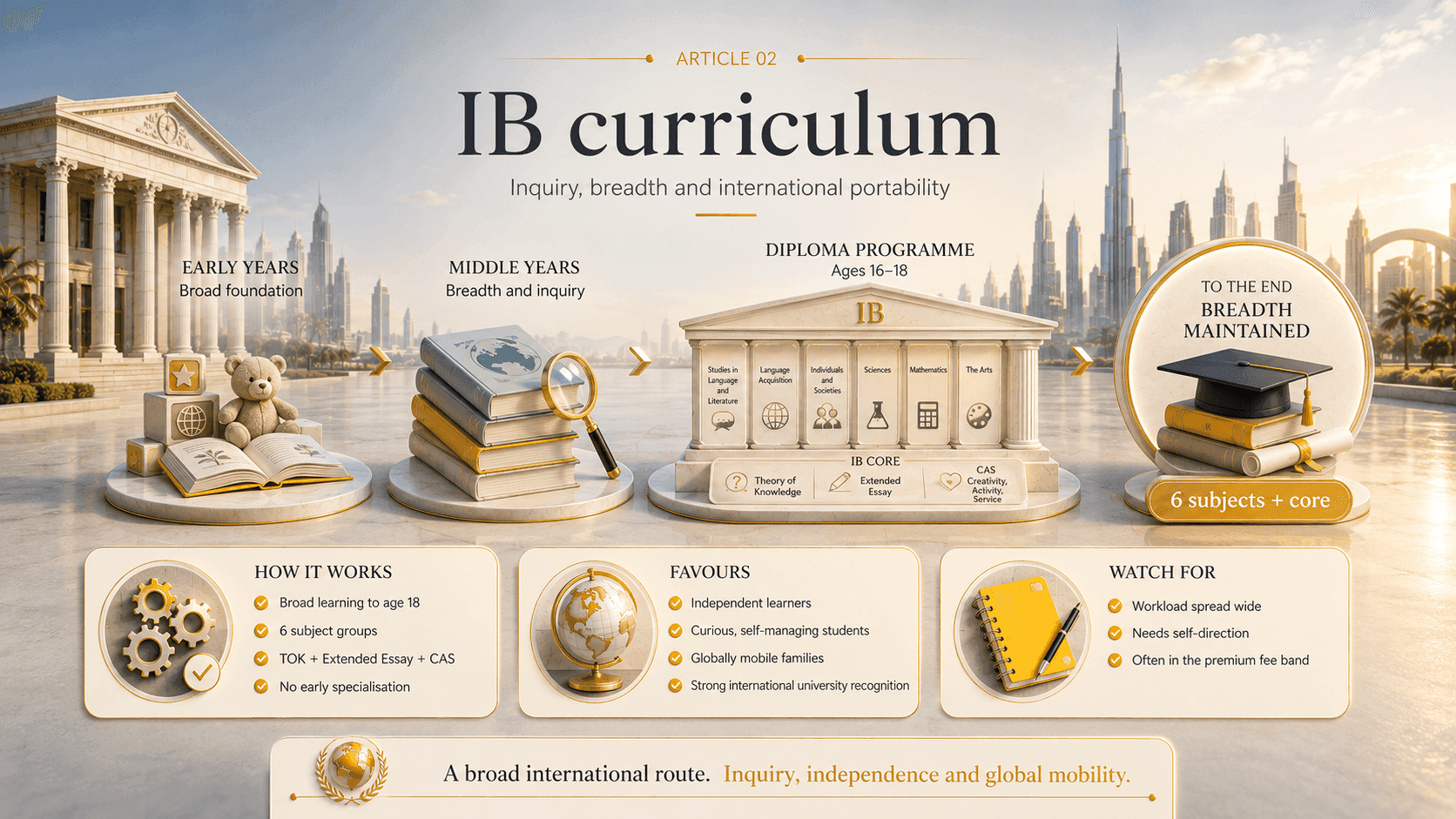
The International Baccalaureate is a philosophy as much as a syllabus. It emphasises inquiry, breadth and connections between subjects. In the Diploma Programme at ages 16-18, students take six subject groups plus theory of knowledge, an extended essay and community activity.
IB avoids early narrowing. The trade-off is a wide and sustained workload.
Often suits: independent, self-managing learners; children who naturally ask why; globally mobile families; students who want to keep university options open across several countries.
Watch for: IB expects self-direction earlier than other systems. The same freedom that energises one child can quietly overwhelm another. IB schools in Dubai also tend to cluster toward the premium end of the fee range.
What does the American curriculum offer?
The American curriculum is built around breadth, flexibility and a credit-based high school diploma, often combined with AP courses for academic depth and SAT or ACT preparation for university admission.
Assessment is generally more continuous and less dependent on a small number of final exams. Elective choice is usually the widest of the four major routes.
Often suits: well-rounded students; late developers who need time before specialising; families oriented toward US and Canadian universities; children with strong interests in arts, athletics, technology or subjects outside the academic core.
Watch for: quality varies widely between American-curriculum schools in Dubai because the model is less standardised. The individual school's outcomes, accreditation and course offering matter more than the curriculum label alone.
How does the Indian curriculum work, and who is it for?
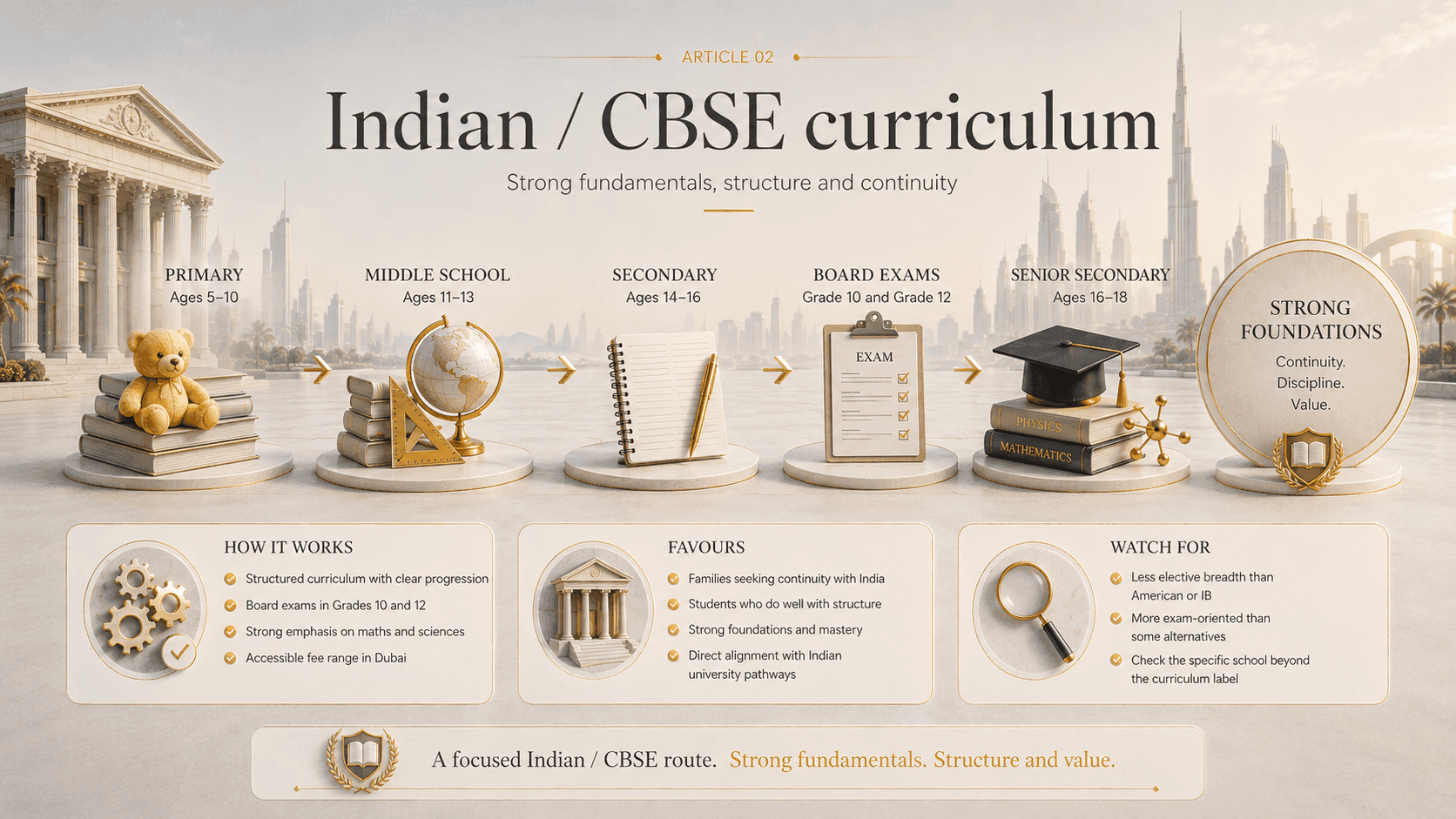
CBSE and ICSE schools form one of Dubai's largest curriculum segments. They offer a rigorous, structured and exam-oriented route, with strong foundations in mathematics and sciences and board examinations in Grades 10 and 12.
For many families, this is not simply one option among four. It is the natural continuity route because of prior schooling, future university plans, family mobility or preparation for Indian entrance examinations.
Often suits: families planning a return to India; students targeting Indian universities or entrance exams such as JEE and NEET; children who do well in structured, mastery-driven environments; families seeking strong academics at a more accessible fee level.
Watch for: the curriculum offers less elective breadth than American or IB routes. For a child whose strengths sit outside the core academic subjects, check what the individual school provides around the main syllabus.
CBSE introduced AI as an elective from Grade 8 in 2019, ahead of many other systems.
How do British, IB, American and Indian curricula compare?
| Curriculum | Typical learning style | Later pathway | Main strength | Main watch-out |
|---|---|---|---|---|
| British | Structured, milestone-driven | UK and international universities | Depth and clear progression | Earlier specialisation and exam density |
| IB | Independent, inquiry-led | Highly portable globally | Breadth and international flexibility | High self-management load |
| American | Broad, flexible, continuous assessment | US, Canada and international universities | Electives and late specialisation | Quality varies widely by school |
| Indian / CBSE | Structured, mastery-driven | India and international universities | Strong fundamentals and continuity | Less elective breadth |
This table is a starting point, not a verdict. Two children with the same university destination may still need different systems.
How do the four compare on cost?
Dubai tuition overall runs from under AED 10,000 to above AED 100,000 per year, and curriculum is one of the strongest predictors of where a school sits in that range.
As broad tiers:
- Indian curriculum schools occupy the most accessible band.
- American and British schools span the widest range, from mid-market to premium.
- IB schools cluster more heavily toward the upper band.
There are exceptions in every direction. Add roughly 10-20% on top of tuition for deposits, uniforms, transport, exams, devices, trips and activities. The full breakdown is here: How much does school really cost in Dubai?
Fee increases are regulated by KHDA and tied to inspection ratings and the Education Cost Index, so a school's current price is reasonably predictive of its near-future price. For 2026-27 specifically, the question is settled outright: tuition is frozen at every Dubai private school.
Can your child switch curricula later?
Yes, but switching is rarely neutral.
The systems sequence content differently, so a child may encounter gaps and repetition at the same time. The later the move, the greater the disruption. Switches after age 14 can land directly inside GCSE, A-Level, IB Diploma, AP or board-exam preparation.
The practical rules:
- For a short posting, continuity often beats switching to a locally more prestigious system.
- If a change is necessary, use a natural boundary such as the start of secondary school or the start of a formal programme.
- Avoid changing mid-cycle unless there is a strong reason.
So how do you choose the right curriculum for your child?
Run the three questions in order.
Destination: UK may lean British. US or Canada may lean American or IB. Maximum international portability may lean IB. India may lean CBSE.
Learner: children who prefer structure and milestones may lean British or Indian. Independent inquirers may lean IB. Broad, still-exploring learners may lean American.
Duration: short stays favour continuity. Longer stays allow a wider choice.
A note in first person, from our team: the pattern we see again and again is parents choosing a curriculum by destination alone and discovering the learner question two years later. The destination question is easier to answer. The learner question is the one worth sitting with. A child who matches the system studies the same material with far less friction.
Curriculum narrows Dubai's 227 schools to a shortlist. Within that shortlist, schools following the same curriculum can still differ enormously in pressure, warmth, structure and independence, which is why children can struggle even in outstanding schools. That second layer is what our matching engine assesses across 36 profile-environment combinations: find your child's school match.
FAQ
- Which curriculum is most popular in Dubai?
- British and Indian curricula lead enrolment, with American and IB forming the other two major segments. In total, Dubai's 227 private schools offer 17 curricula.
- Which curriculum is cheapest in Dubai?
- Indian curriculum schools generally occupy the most accessible fee band. IB schools cluster toward the premium end, while British and American schools span the widest range in between.
- Is IB harder than A-Levels?
- They are difficult in different ways. IB demands breadth across six subjects plus core components. A-Levels demand greater depth in three or four subjects. Broad self-managers may find IB more natural; deep specialists may prefer A-Levels.
- Do universities prefer one curriculum?
- Universities accept all four. What differs is friction. A-Levels map directly to UK admissions, AP and SAT align naturally with the US, IB travels widely, and CBSE aligns closely with Indian entrance pathways.
- Can my child switch from CBSE to British, or British to IB?
- Yes, ideally at a natural boundary and preferably before age 14. Mid-cycle changes can create simultaneous gaps, repetition and exam disruption.
- Do families usually compare all four curricula?
- No. Some families genuinely compare British, IB and American schools. Others begin with CBSE because continuity with the Indian education system is already an important requirement. The purpose of this guide is to explain the four major routes, not to suggest that every family chooses among all four equally.
Sources
- 227 private schools, 17 curricula, fee range under AED 10,000 to above AED 100,000: KHDA data, 2025-26
- KHDA School Fees Framework and Education Cost Index: KHDA
- CBSE optional AI subject from Grade 8: Central Board of Secondary Education, India, 2019
Related articles
- How much does school really cost in Dubai in 2026?Tuition is only the visible number. Deposits, capital fees, buses, uniforms, exams: the full cost of a Dubai school in 2026, with a realistic budgeting rule.
- Dubai school fees are frozen for 2026-27: what does it mean for parents?KHDA has confirmed no tuition increases for Dubai private schools in 2026-27. What the freeze covers, what it does not, and how to use the year it buys you.
- Why do children struggle in "outstanding" schools? The goodness-of-fit problemSome children struggle in top-rated schools, and it is neither side's fault. Seventy years of goodness-of-fit research explains why, and what to check instead.