
How do I choose a school in Dubai? A step-by-step guide for 2026
Choosing a school in Dubai is five decisions made in order: which curriculum, what real budget, which location, whether the school is good, and whether the school's environment fits your particular child. Most parents make only the first four and rely on ratings for the fifth. That is exactly where good-on-paper choices go wrong.
By Dubai School Match · Published 5 July 2026 · Last updated 5 July 2026

This guide walks through all four decisions with current numbers, explains why you cannot fully rely on KHDA ratings right now, and covers the new admission age rule that takes effect from the 2026-27 academic year.
In this article
- Why is choosing a school in Dubai harder than almost anywhere else?
- Step 1: Which curriculum should you choose?
- Step 2: What is your real budget?
- Step 3: How much does location matter?
- Step 4: Is this a good school?
- Step 5: Is this the right school match for my child?
- When should you start the process?
- FAQ
Why is choosing a school in Dubai harder than almost anywhere else?
Because of scale and variety at the same time. Dubai has 227 private schools offering 17 different curricula to more than 387,000 students from 185 nationalities. Annual tuition runs from under AED 10,000 to above AED 100,000. The sector grew 6% in enrolment in 2024-25, and 25 new private education institutions opened for the 2025-26 academic year alone.
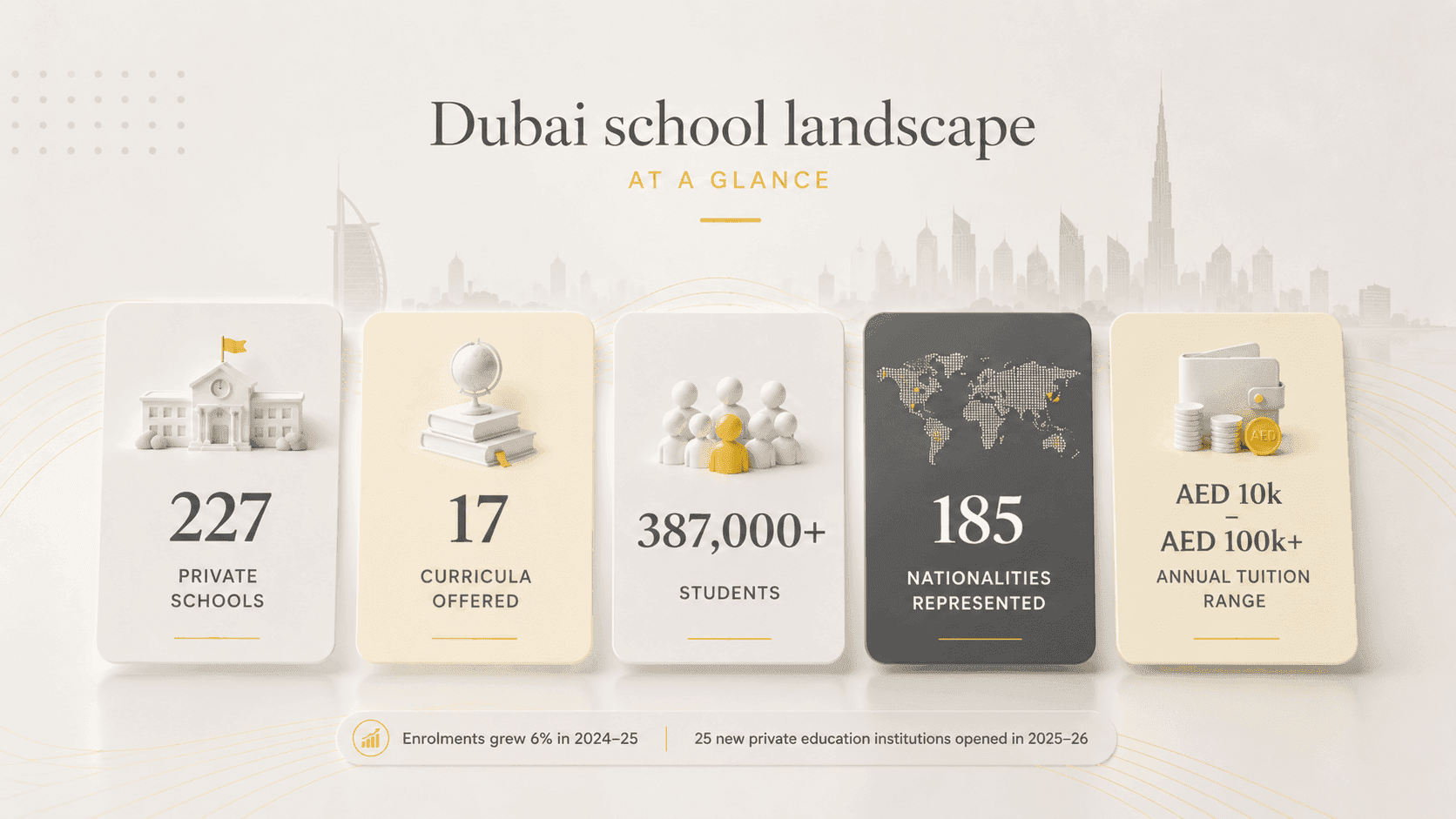
In most cities parents choose between a handful of local options. In Dubai you choose between education philosophies, national systems, price tiers and communities, often within a fifteen-minute drive of each other. More choice is a privilege, but it also means a wrong choice is entirely yours to make. A process helps. Here is one.
Step 1: Which curriculum should you choose?
Start with curriculum because it narrows 227 schools faster than any other filter, and because it is the hardest thing to change later.
The practical questions that decide it:
Where will your child study after school? If university in the UK is likely, British curriculum (GCSE, A-Levels) keeps the path smooth. For the US, American curriculum or IB. For maximum flexibility across countries, IB is the most portable. For families planning a return to India, CBSE keeps the transition painless.
How does your child learn? British and Indian systems are more structured and exam-driven. IB is inquiry-based, with more independence expected from the student, which suits some children and overwhelms others. American programmes tend to sit in between, with more room for electives.
How long are you staying? If Dubai is a two-year posting, continuity with your home system usually beats an objectively "better" school in a different system. Switching curricula mid-childhood costs more academically than most parents expect.
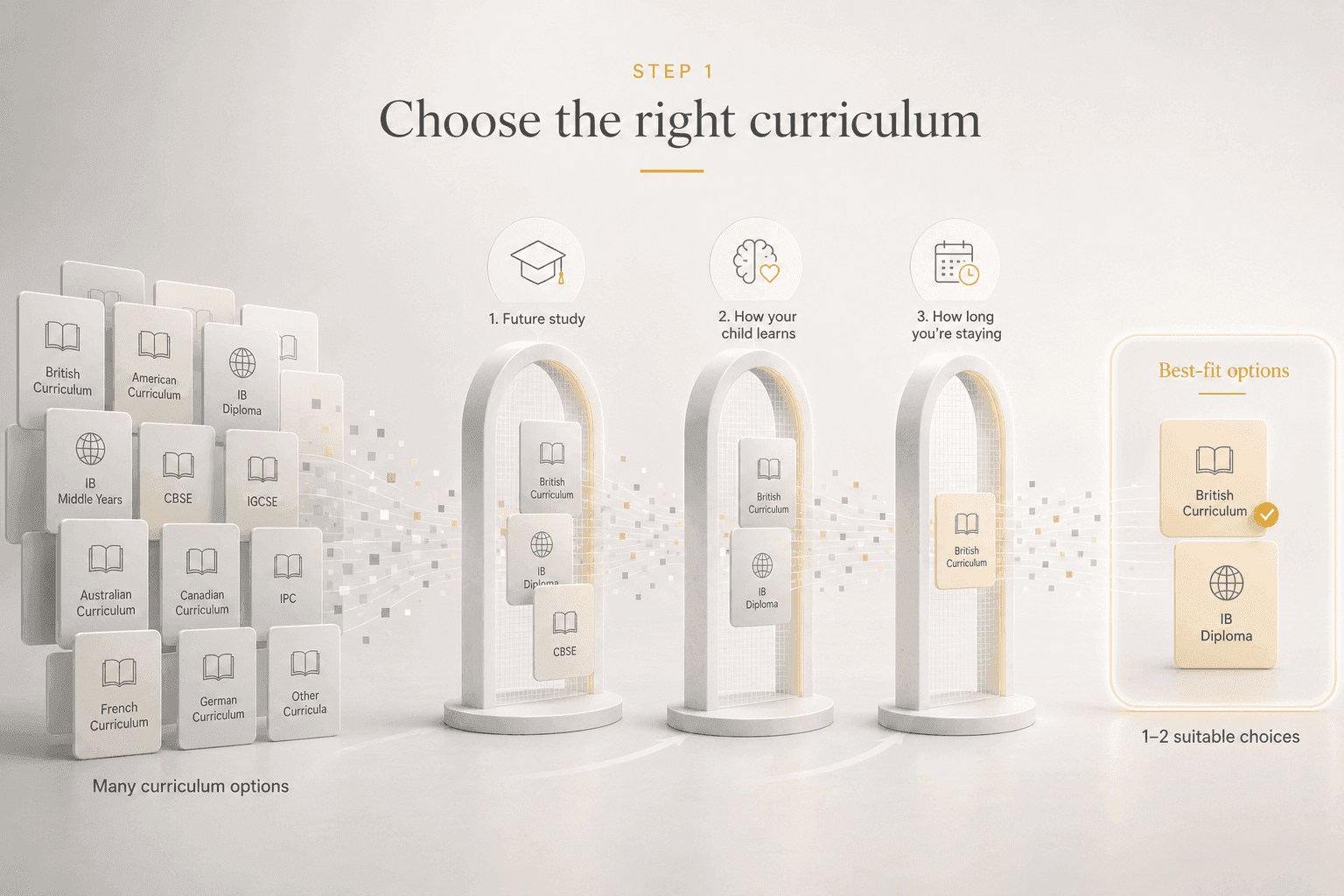
A full comparison with fee ranges and outcomes deserves its own article, and it has one: Which curriculum is best in Dubai?. For this step, the output you need is simple: one, at most two, curriculum choices. That typically cuts your list from 227 schools to somewhere between 20 and 70.
Step 2: What is your real budget?
Tuition is the visible number. The real number is higher, and Dubai school budgets fail on the invisible part.

Beyond tuition, plan for: a registration deposit, usually 10% of annual tuition, payable on accepting an offer and generally non-refundable though deductible from the first term; uniforms; school transport, if you use the bus; exam fees in senior years; trips, devices and activity costs that vary widely by school.
Two features of the Dubai fee system are worth knowing. First, fee increases are regulated: under the KHDA School Fees Framework, the maximum increase a school can apply for is tied to its inspection rating and the annual Education Cost Index. Second, schools operating in Dubai for fewer than three years are not eligible to request fee increases at all, which can make newer schools a more cost-stable option in the short term.
Most schools offer instalment plans, typically three termly payments, and some accept monthly payments at a small premium. Budget honestly for the full number, not the brochure number, and decide your ceiling before you fall in love with a school that sits 20% above it. The detailed cost breakdown lives here: How much does school really cost in Dubai?.
Step 3: How much does location matter?
More than parents admit and less than they fear.
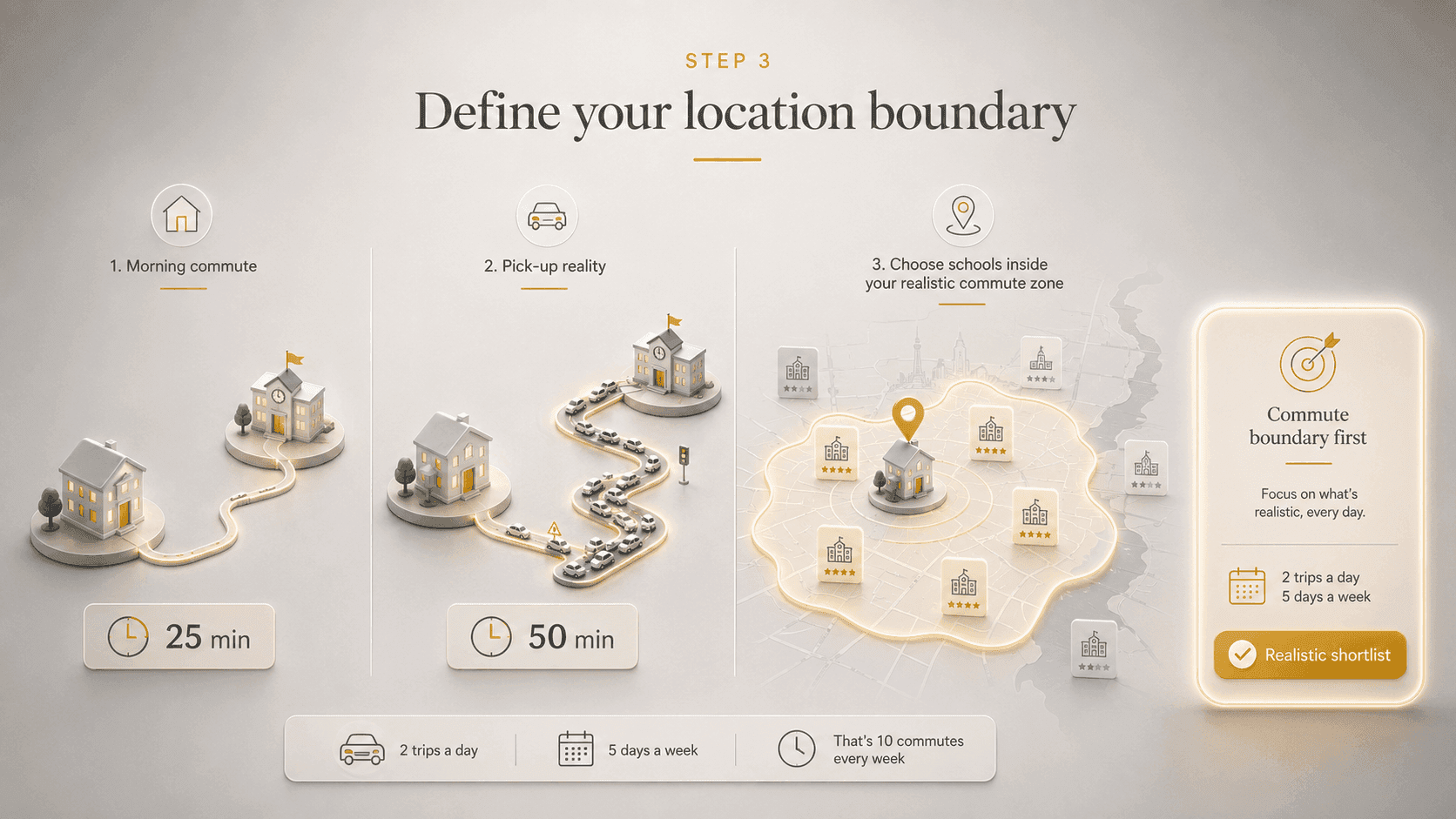
The Dubai reality: traffic defines childhood logistics. A school 25 minutes away at 7am can be 50 minutes away at pickup. Multiply by two trips a day, five days a week, thirteen years. Location is not about prestige of the area, it is about the daily energy of your child and whoever does the driving.
The practical rule: draw a realistic commute boundary first (most families land on 20-25 minutes door to door), list the schools from your Step 1 shortlist inside it, and only then consider whether any school outside the boundary is genuinely worth breaking it for. Some are. Most are not.
If you are still choosing where to live, reverse the order: pick the school community first, then the home. In Dubai, moving house is easier than moving schools.
Step 4: Is this a good school?
As your foundation, with one thing in mind about timing.
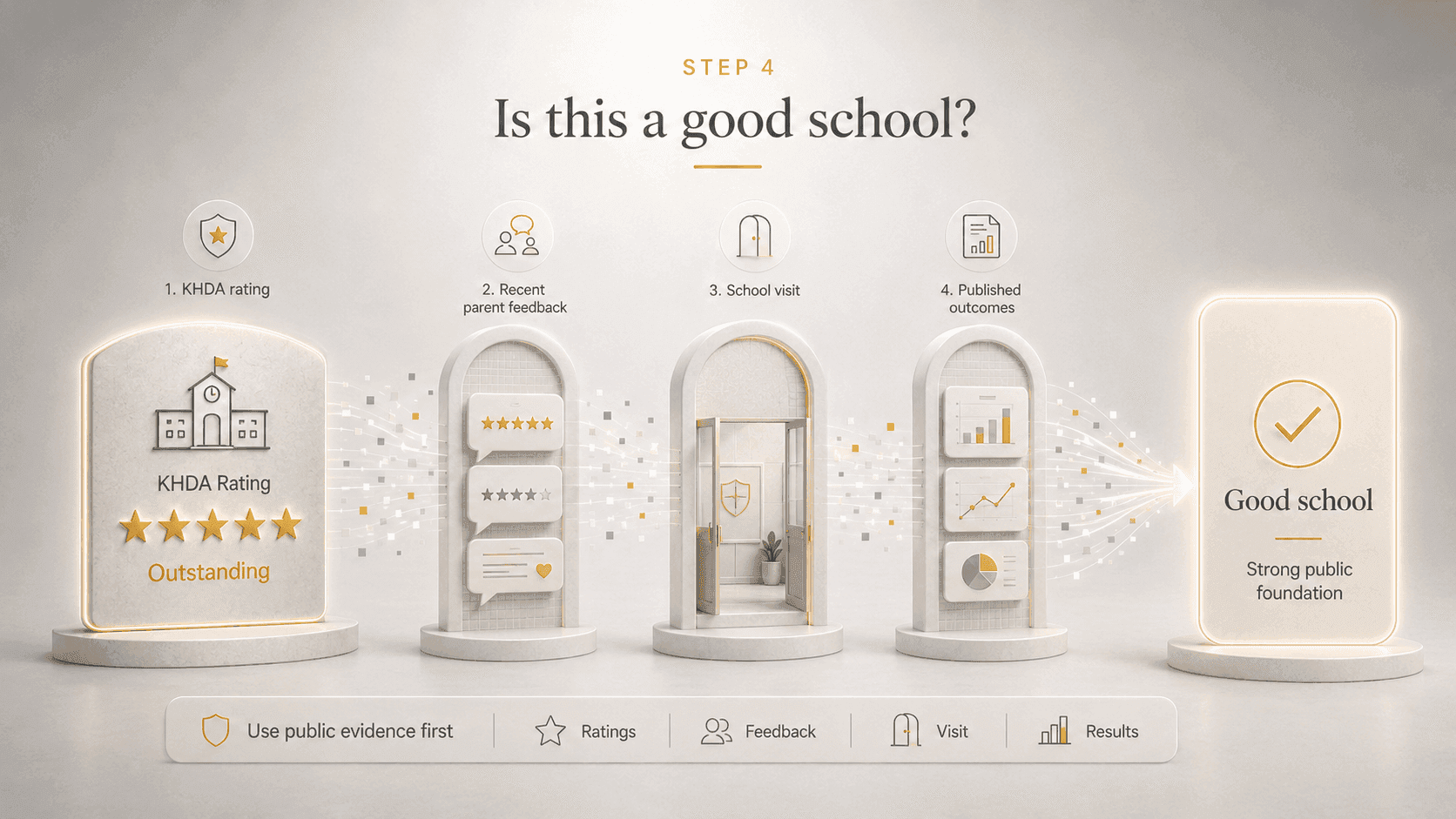
KHDA ratings are the most rigorous public data that exists on Dubai schools: independent inspections, a consistent framework, published openly. Any serious school search starts there, and ours does too.
KHDA has paused full annual inspections for 2024-25 and 2025-26 to give schools room for internal development and self-evaluation, so most schools currently carry their rating from the 2023-24 cycle. Targeted quality assurance visits continue. For parents this simply means the published rating is a snapshot from a moment in time, and a school may have grown since it was taken.
The sensible response is not to discard ratings but to complement them: recent parent community feedback, a school visit, the school's own published results, and one dimension no inspection is designed to capture, because it is not about the school alone: the match between this school's environment and your particular child. An Outstanding school with a high-pressure academic culture is a superb setting for one child and a poor one for another, and both facts are consistent with the rating being entirely accurate. Ratings answer "is this a good school?" The question that completes the picture is "is this a good school for mine?" More on that: Why do children struggle in outstanding schools?
Step 5: Is this the right school match for my child?
This is the decision most parents never consciously make, because nothing in the standard process forces them to.
Curriculum, budget and location are questions about your family. Fit is a question about your child as an individual: how they respond to competition, how much structure they need, whether they open up in a crowd of 30 or a group of 12, what happens to them under pressure, what happens to them without it.
Schools differ on these dimensions as much as they differ in price. There are high-octane academic environments, warm nurturing ones, structured and traditional ones, open project-driven ones. None of these is better in general. Each is better for some children and worse for others. Decades of research on person-environment fit points the same direction: outcomes follow the match between the person and the setting, not the prestige of the setting alone.

Here I will speak in first person, as one of the people who built this site. I moved through the Dubai school search the way most professional parents do: spreadsheet, ratings, fees, shortlist. I work with data for a living, and my spreadsheet was excellent. It took me embarrassingly long to notice that not one column in it described my own child. Everything measured the schools. Nothing measured the match. That gap is the reason this site exists.
The output of Step 5 is not a score from a table. It is an honest one-page profile of your child, held up against the two or three finalists from Steps 1-3, and a school visit where you watch your child in the space, not the marketing. If you want structure for this step, that is precisely what our matching quiz does: find your child's school match.
When should you start the process?
Earlier than feels natural. For an August start, popular schools open applications the previous autumn, and waiting lists at the most in-demand schools are real, though at many others they are a soft marketing tool. Mid-year admission is possible at plenty of schools, especially outside the top-demand tier.
One rule change to have on your radar: from the 2026-27 academic year, the admission age cut-off moves from 31 August to 31 December of the admission year, for all public and private schools, nurseries and early childhood centres starting their year in August or September. If your child is born between September and December, this changes which year group they enter. The full calendar, deadlines and waiting list reality check are covered in When should I apply to Dubai schools?.
FAQ
- How many private schools are there in Dubai?
- 227 private schools offering 17 curricula to over 387,000 students, regulated by KHDA. Around 25 new private education institutions opened for 2025-26 alone.
- What is the best school in Dubai?
- There is no single answer, and that is not evasion. Schools rated Outstanding differ sharply in environment, pressure and teaching style. The best school is the best match for your child's profile within your curriculum, budget and location constraints.
- Are KHDA ratings up to date?
- Full inspections are paused for 2024-25 and 2025-26, so most schools carry their rating from the 2023-24 cycle. Ratings remain the best public foundation for a school search; complement them with a visit, parent feedback and a look at fit with your child.
- How much should I budget for school in Dubai?
- Tuition spans under AED 10,000 to above AED 100,000 per year. Add roughly 10-20% on top for the registration deposit, uniforms, transport, exams and activities, depending on the school.
- What changes with the new admission age rule?
- From 2026-27, the cut-off date moves from 31 August to 31 December. Children born September to December will fall into a different year group than under the old rule.
- How long does the whole process take?
- For a comfortable run: 6-9 months from first shortlist to signed offer for an August start. Compressed versions are possible, but they cost you Step 5, and Step 5 is the one that predicts whether the choice holds.
Sources
- 227 private schools, 17 curricula, 387,441 students, 185 nationalities, fee range: KHDA data, 2025-26
- 6% enrolment growth in 2024-25 and 25 new institutions in 2025-26: KHDA announcements, 2025
- Inspection pause for 2024-25 extended through 2025-26; ratings carried from 2023-24 cycle: KHDA
- KHDA School Fees Framework, Education Cost Index, three-year rule for new schools: KHDA
- Admission age cut-off change from 2026-27 (31 August to 31 December): UAE Education, Human Development and Community Development Council, December 2025
Related articles
- British, IB, American or Indian: which curriculum is right for your child in Dubai?British, IB, American or Indian curriculum in Dubai: how each route works, who it suits, what it costs and how to choose the right one for your child.
- How much does school really cost in Dubai in 2026?Tuition is only the visible number. Deposits, capital fees, buses, uniforms, exams: the full cost of a Dubai school in 2026, with a realistic budgeting rule.
- Why do children struggle in "outstanding" schools? The goodness-of-fit problemSome children struggle in top-rated schools, and it is neither side's fault. Seventy years of goodness-of-fit research explains why, and what to check instead.